Indo-Caribbean History
is Asian American History
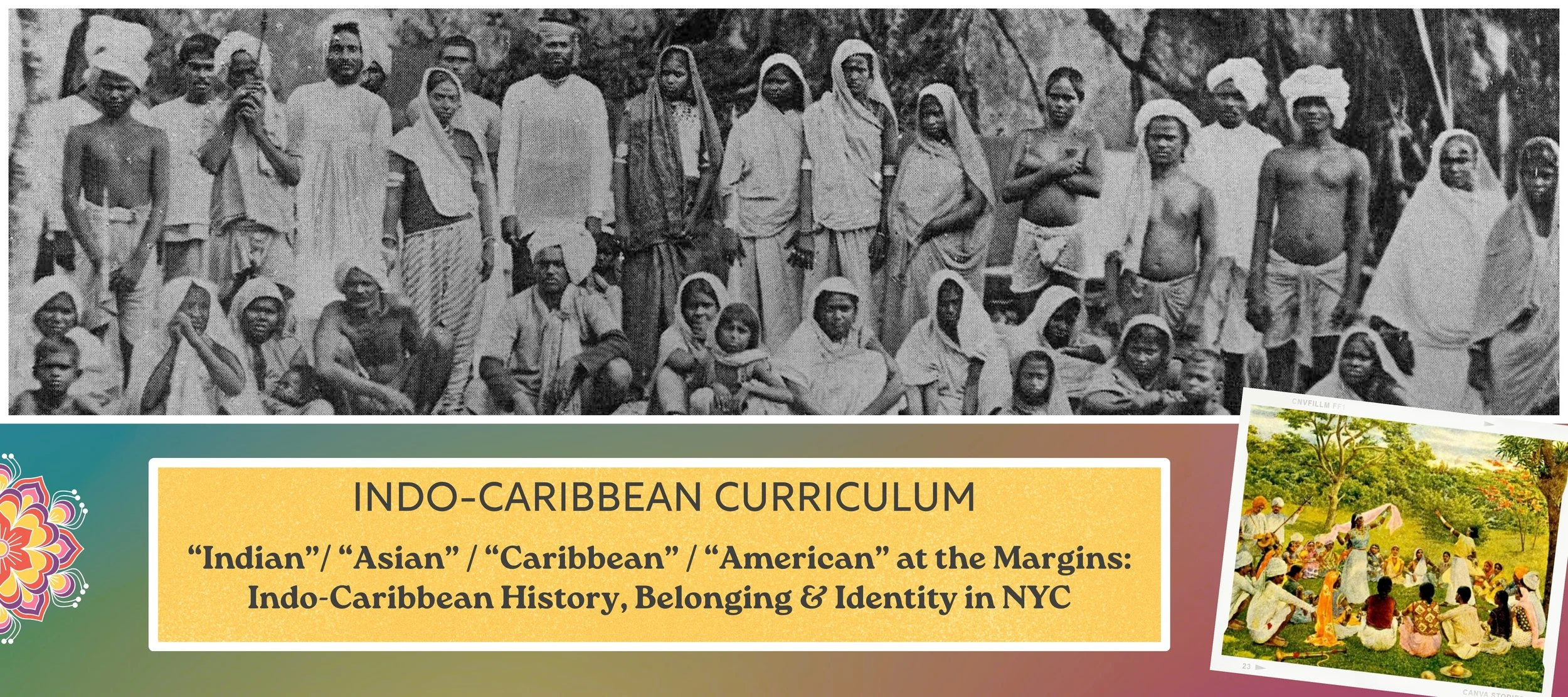
Indo-Caribbean Curriculum
“Indian / Asian / Caribbean / American at the Margins: A Critical Introduction to Indo-Caribbean History, Identity and Belonging in New York City” is a 10-lesson unit developed by the Caribbean Equality Project and written by Dr. Ryan Persadie for students in grades 6–12. Designed for Social Sciences, History, and English courses, it invites young people to study Indo-Caribbean life from 1838 to the present through music, oral histories, primary documents, and contemporary community organizing in New York City.
The historic and first-of-its-kind 10-lesson curriculum is a standards-aligned, inquiry-based unit that introduces grades 6–12 to Indo-Caribbean history, identity, and community organizing in New York City, centering racial capitalism, double diaspora, and gender and queer justice as core lenses for social studies and English classrooms. It equips educators with ready-to-use lesson plans, primary sources, and arts-based activities that amplify Indo-Caribbean voices while meeting New York State Social Studies learning standards.
The unit is organized into three streams: Kala Pani Journeys (Indian arrival and indenture in the Caribbean), The Double Diaspora (Indo-Caribbean migration to the United States), and Building New Asian Americas (gender justice, queer liberation, food justice, and cross‑racial solidarity in NYC). Students analyze the relationship between slavery and indentureship, examine how “Indianness,” “Asianness,” “Caribbeanness,” and “Americanness” are constructed, and connect historical forces to present-day struggles for LGBTQI+ rights, gender equity, and food sovereignty.
Throughout the unit, students read and interpret primary and secondary sources, engage in collaborative projects, and create multimodal work such as visual maps, reflective letters, advocacy posters, and podcast-style interviews. Assessments are differentiated and include reading reflections, argumentative writing, experiential research, popular culture analysis, and group presentations, with built‑in accommodations for diverse learners. The curriculum aligns with New York State Social Studies Learning Standards (History of the United States and New York, World History, Geography, Economics, and Civics, Citizenship & Government) and is adaptable for elementary and adult learning spaces.
Caribbean Equality Project offers a one-hour training and presentation for educators, students, community leaders, and service providers to support implementation of the unit across classrooms, youth programs, and community settings.
Breakdown of the 10 Lessons


Stream 1: Kala Pani Journeys – Histories of Indian Arrival to the Caribbean
Lesson 1 – Introducing the Indo-Caribbean (60 minutes)
Students explore the push factors behind Indian indentureship (c. 1838–1917), connecting the abolition of the transatlantic slave trade and the rise of the Indian nation‑state to British demands for plantation labor. Using Mighty Sparrow’s calypso “Marajhin” and Mahatma Gandhi’s 1922 speech “The Inequities of the Indenture System,” they analyze colonial representations of Indian communities and develop a transnational understanding of Indo-Caribbean arrival.
Lesson 2 – Distinguishing between Slavery & Indenture (120 minutes)
This extended lesson introduces students to slavery and indentured servitude as interconnected but distinct systems of involuntary labor in the Caribbean. Students watch Ruth Wilson Gilmore’s “Geographies of Racial Capitalism,” create visual definitions of racial capitalism, and read excerpts from Mary Prince and Mariam Pirbhai to map similarities and differences between chattel slavery and indenture, emphasizing cross‑racial solidarity between African and Indian communities.
Lesson 3 – Indo-Caribbean Resistance in Colonial Times: Hosay & Chutney (90 minutes)
Students study Hosay processions and Chutney music as cultural practices of resistance and religious/cultural mixing among Indo-Caribbean communities. Working in groups, they analyze videos, images, and poetry to build collaborative mind maps that trace how embodied traditions, syncretism, and popular culture challenge colonial power and reimagine Indo-Caribbean identity.
Stream 2: The Double Diaspora – Indo-Caribbean Migration to NYC
Lesson 4 – Introducing the Double Diaspora (60 minutes)
Learners are introduced to the concept of “double diaspora,” focusing on migration from India to the Caribbean and then from the Caribbean to the United States. Reading Rajiv Mohabir’s “Minority Identity Development Model for an Indo-Caribbean American in Five Stages,” they connect his stages of minority identity development to their own lived experiences through reflective letters to their past or present selves.
Lesson 5 – LGBTQI+ Indo-Caribbean Migration to NYC (120 minutes)
Students explore the Queer Caribbeans of NYC digital exhibit, focusing on queer Indo-Caribbean pioneers and organizations from the 1960s to today. In small groups, they script and record short video interviews, posing discussion questions about a selected figure or organization (such as Mohamed Q. Amin, Zaman/Sundari, Chutney Pride, or Curry Club NYC) and reflecting on how queer Indo-Caribbean migration differs from heteronormative narratives.
Stream 3: Building New Asian Americas – Activisms and Community Organizing
Lesson 6 – Principles of Gender Justice in Indo-Caribbean Communities (150 minutes)
Students examine feminist and queer organizing led by Indo-Caribbean groups such as Caribbean Equality Project, South Queens Women’s March, Jahajee, and the Blasian March. Through videos and archives focused on gun violence, trans rights, gender‑based violence, and cross‑racial solidarity, they document key principles of gender justice and then create advocacy posters that visually communicate a chosen tenet to broader communities.
Lesson 7 – Food Justice in the Indo-Caribbean Community (120 minutes)
This lesson introduces food justice and food sovereignty, especially in the context of COVID‑19’s impact on Indo-Caribbean New Yorkers. After reading Neela Jain’s article “New York City food pantries work to give immigrants a taste of home,” students complete an intersectionality mapping organizer to trace how race, gender, class, sexuality, and other factors shape food insecurity and co‑author an argumentative paragraph on why intersectional analysis is necessary to confront food injustice.
Lessons 8–10 – Extended research, reflection, and community engagement
The final lessons (described in the full curriculum) are designed to deepen students’ qualitative research, writing, and public presentation skills through cumulative projects that synthesize Indo-Caribbean history, identity, and community organizing in NYC. They may involve independent or group research, experiential activities, and public-facing products such as presentations or digital storytelling, allowing educators to adapt the sequence to local contexts and timeframes.
Support & Funding Provided By: